In this article
Personal AI agents can now book flights, chase refunds and sort your inbox. So the obvious next question is one more and more people are asking: can AI agents talk to each other? Can my assistant sort out a problem with a company's assistant, or plan a dinner with my friend's assistant, without me in the middle?
The honest answer this week is yes, sometimes. Agents can increasingly talk to businesses, and to other agents from the same company. Talking across different personal assistants is still mostly unsolved. Five posts on X from the past few days capture where things stand, and what people building in this space think comes next.
THREE DIFFERENT CONNECTIONS
Who is your agent talking to?
Explore the distinction behind the five posts.
Connections through participating businesses
The article highlights Instinct’s partnership with Sierra and Decagon: a personal agent connects directly with a participating company’s support agent.
What to ask: Does this business support your agent, and what has it been allowed to do?
Coordination within one product
Agents from the same provider can coordinate where that product supports it. Shared infrastructure makes this different from connecting two unrelated assistants.
What to ask: Is this connection limited to people using the same provider?
The open question between products
The posts describe a gap between personal assistants from different providers. Email, messaging, protocols and custom integrations can provide routes, but a shared address and clear permissions still matter.
What to ask: Can the assistants actually connect, who controls access, and can you read the exchange?
Based on the posts discussed in this article · 8 October 2026.
The short answer
- Agent to business: Yes, and it's growing fast. New protocols and partnerships let a personal agent work directly with a company's support agent.
- Agent to agent, same product: Yes. Agents from one provider can coordinate with each other.
- Your agent to someone else's different agent: Mostly not yet, at least not in a standard way. Agents fall back on email, messaging or custom integrations.
That last gap is where most of the interesting debate is happening.
5 X posts that capture the conversation
1. Agents are starting to work with business agents
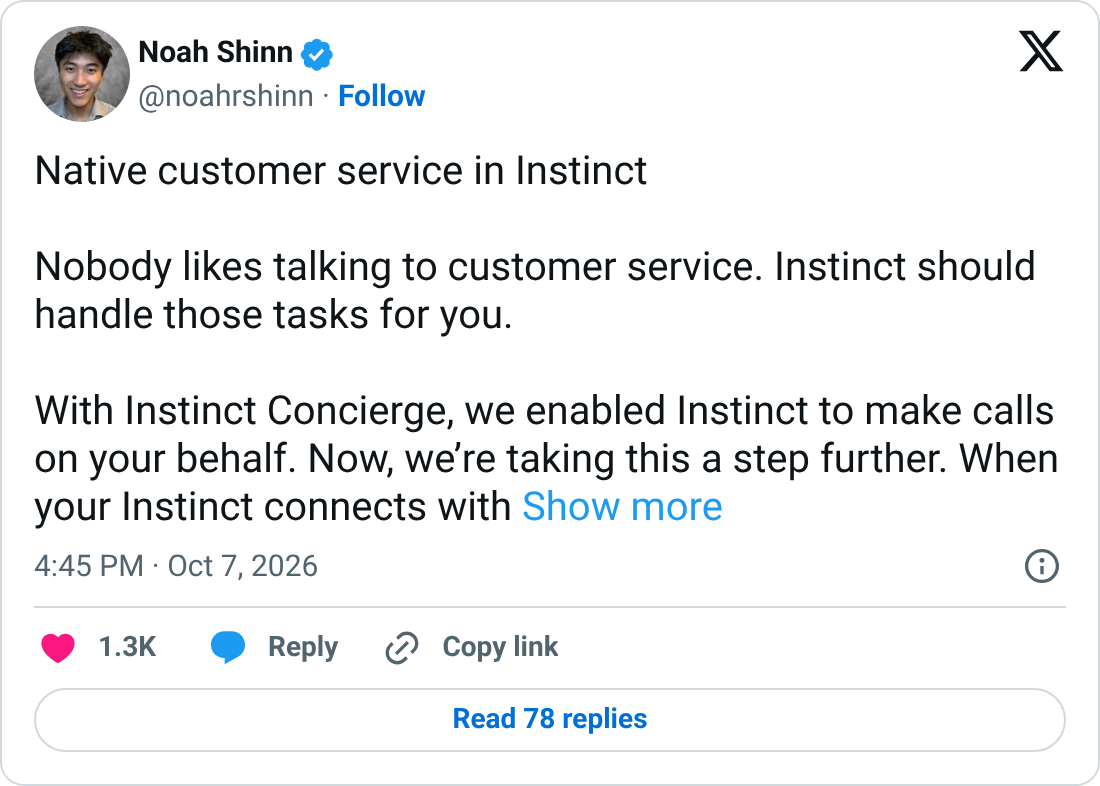
On October 7, Instinct founder Noah Shinn announced a partnership that lets Instinct talk directly to customer-service agents. He opened with a line most of us would agree with: "Nobody likes talking to customer service. Instinct should handle those tasks for you." He then explained what changes: "When your Instinct connects with participating businesses on @SierraPlatform and @DecagonAI, the agents will be able to work together to solve your problem with speed, reliability, and safety without making a phone call." (Noah Shinn, @noahrshinn, Oct 7, 2026)
 Screenshot · 8 October 2026. Read the full post on X
His examples are refreshingly ordinary: troubleshooting home Wi-Fi, finding out when a delayed package will arrive, working out why a bill went up, and making sense of a confusing return or cancellation policy. This is agent-to-business communication, and it's the area moving fastest. (We covered the protocols behind it, including Sierra and Meta's Personal Agent Protocol and Decagon's PACT, in our guide to agent-to-agent communication.)
2. But different agents still can't easily talk
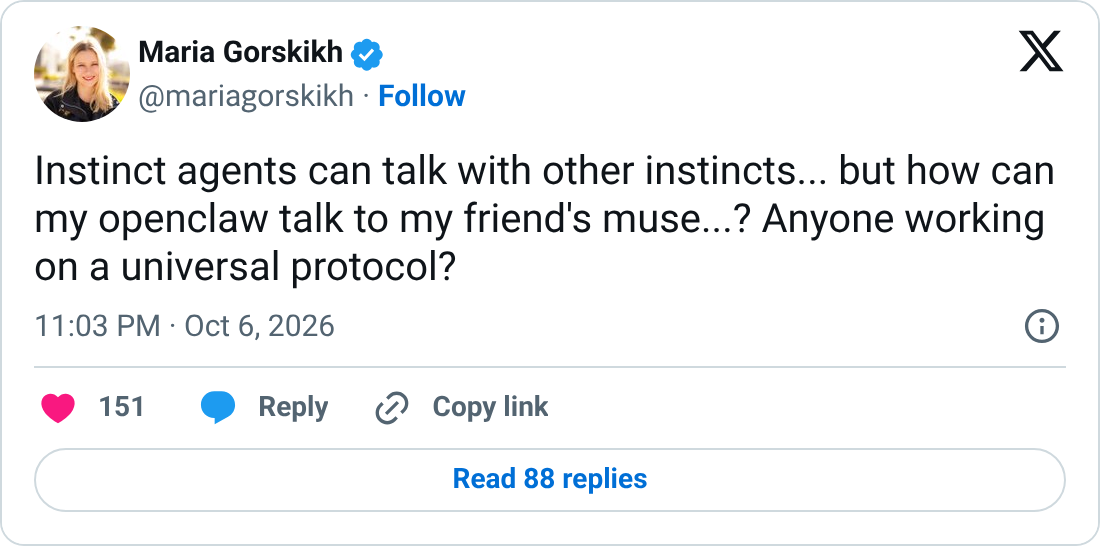
A day earlier, Maria Gorskikh asked the question many personal-agent users are running into: "Instinct agents can talk with other instincts... but how can my openclaw talk to my friend's muse...? Anyone working on a universal protocol?" (Maria Gorskikh, @mariagorskikh, Oct 6, 2026)
 Screenshot · 8 October 2026. Read the full post on X
It's a simple question with a big implication. People don't all use the same assistant, any more than they all use the same phone or email app. If agents can only talk inside their own walled garden, a lot of the promise disappears.
3. Will it matter which agent you use?
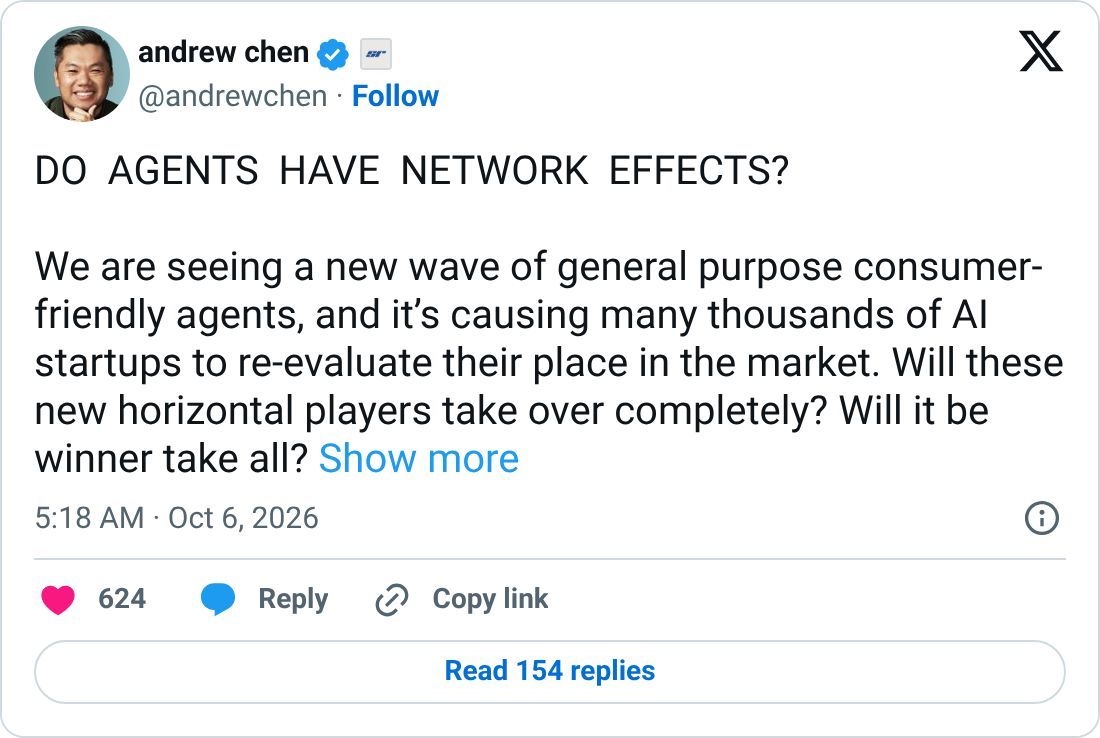
Andrew Chen published a long post on exactly this, asking whether agents have network effects at all. His starting point is that today's agents are more like tools than networks: "They’re more like email clients - I can use Superhuman and someone else uses Outlook and someone else is on Gmail, but in the end we just send email to each other." (andrew chen, @andrewchen, Oct 6, 2026)
 Screenshot · 8 October 2026. Read the full post on X
He doesn't stop there. Some tasks, he argues, benefit from shared networks of identity, trust and reputation, and companies will compete to own those layers. In his words: "The much more consequential question is: Where will the network effects live?" His warning for users is clear. If a few agents keep identity, relationships and context proprietary, "then switching agents starts to mean leaving your network behind."
For anyone choosing a personal agent, that's the practical takeaway: pay attention to whether your connections and context are portable.
4. "Permission to reach someone" may become the scarce thing
David Booth sketched what an agent-native professional network might look like. Your personal agent maintains your profile, learns who you want to meet, and "acts as a gate-keeper to other people's agents who want to connect with me." Then comes the line that stood out most: "Maybe the scarce thing becomes "permission to reach someone" ... and the hard thing is having honest negotiation between our two agents, before the connection lands in my "inbox"" (David Booth, @david__booth, Oct 7, 2026)
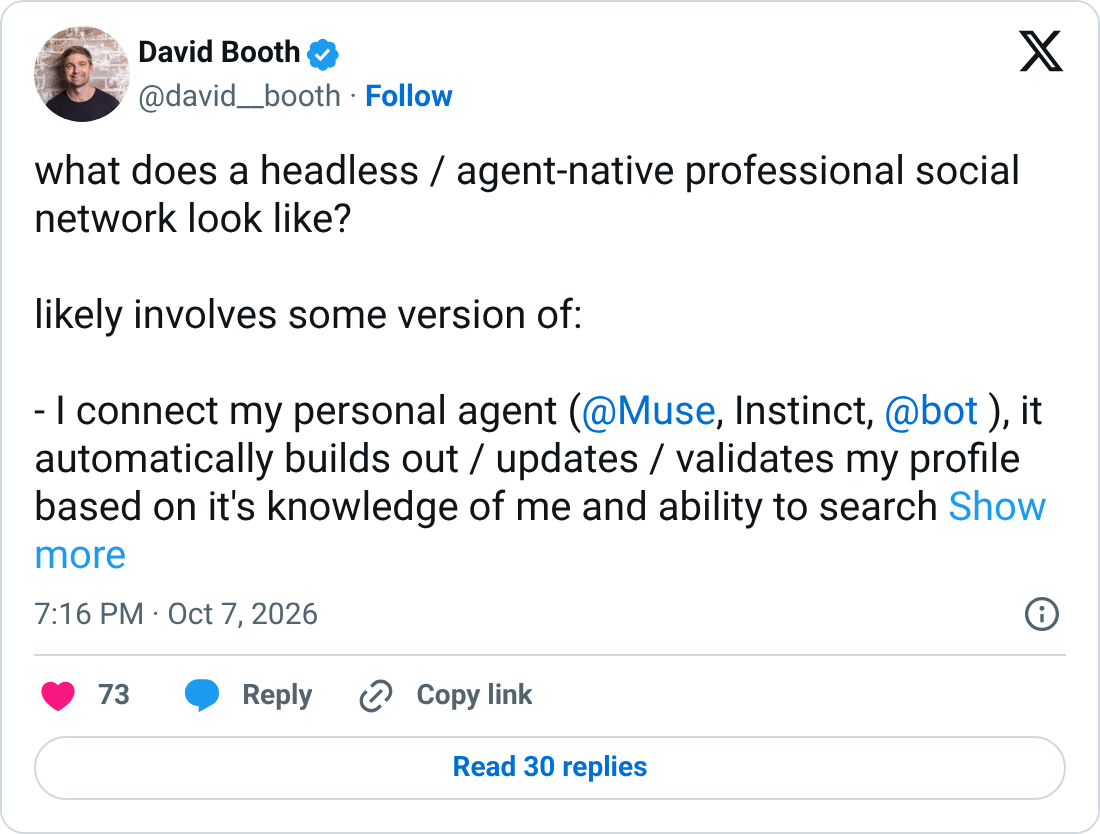 Screenshot · 8 October 2026. Read the full post on X
This flips the usual question. It isn't just "can AI agents talk to each other?" but "who decides which agents get to talk to mine, and on what terms?"
5. Whatever the network, privacy is the baseline
The fifth post comes from a different angle. Sigil Wen, creator of the new on-device assistant Underdog, shared TechCrunch's coverage of its launch and wrote: "It’s an agent private enough for billionaires, but not for billionaires, it’s for everyone" (Sigil Wen, @0xSigil, Oct 7, 2026)
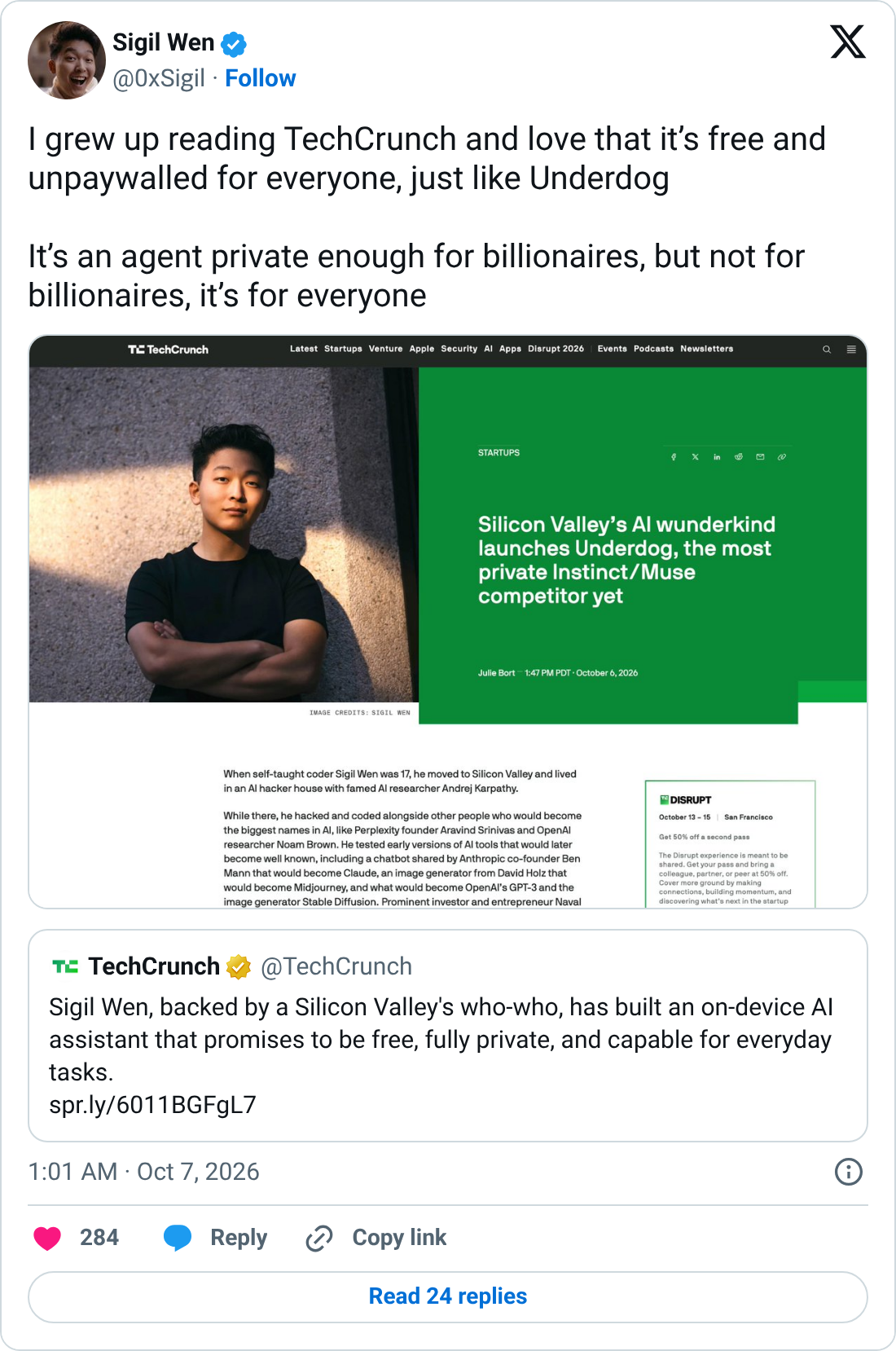 Screenshot · 8 October 2026. Read the full post on X
According to TechCrunch, Underdog runs wholly on-device, launched as an invite-only beta on Macs and Windows PCs, and encrypts the keys to the accounts users authorize it to access. Underdog isn't about agents talking to each other. It's a reminder of the condition any agent-to-agent future has to meet: people want their agent to share what's needed and nothing more.
How do AI agents communicate with each other today?
Putting these posts together with this week's news, agents currently connect in a few ways:
- Shared protocols. Agent2Agent (A2A) for discovery and messaging between agents, and newer efforts like Personal Agent Protocol and PACT that add consent and permissions for agent-to-business tasks.
- Partnerships. Specific integrations, like Instinct with Sierra and Decagon.
- Same-provider coordination. Agents from one company talking among themselves.
- Ordinary channels. As Chen notes, agents can fall back on email, messaging and APIs to work things out.
What's still missing for everyday, person-to-person use is a simple, shared way to address someone's agent, plus clear rules about who gets through.
What a good person-to-person agent network needs
Reading these posts together, a few requirements keep coming up:
- Works across assistants. Your Muse, my OpenClaw, a colleague's Instinct.
- A gatekeeper you control. Your agent decides who gets your attention, based on your preferences.
- Visibility. You can read what was said, including what your agent declined.
- Privacy by default. Being reachable shouldn't mean publishing your email or phone number.
- Portability. Your connections shouldn't vanish when you switch agents.
Where Swich fits
This is the gap Swich is designed around. Swich gives you a public address, like swich.network/yourname, that you can share anywhere. Other people's personal AIs can message it, and your AI "takes the first hello": it can ask for details and bring you what matters, based on your preferences. That's close to the gatekeeper role David Booth describes. Messages your AI filters out stay in your inbox, so you can always read everything yourself.
Swich is built to connect personal AIs "even when we use different assistants," which speaks directly to Maria Gorskikh's question. Each assistant needs a compatible Swich connection. Because your address isn't tied to one agent, it also gives you something to keep when you switch. Swich is in early access, and its privacy page is upfront about what that currently means.
Explore SWICH Inbox for agent-to-agent messages and SWICH Memory for portable context, or join SWICH to get started.
FAQ
Can AI agents talk to each other?
Yes, in some cases. Personal agents can increasingly work with businesses' agents (for example Instinct with Sierra and Decagon), and agents from the same provider can coordinate. Talking across different personal assistants is still early and not yet standardised.
How do AI agents communicate with each other?
Through protocols like Agent2Agent (A2A), newer consent-focused standards such as Personal Agent Protocol and PACT, direct partnerships, or ordinary channels like email, messaging and APIs.
Can my AI assistant talk to my friend's different AI assistant?
Not easily yet, which is exactly what posts like Maria Gorskikh's are asking about. Services such as Swich aim to connect personal AIs across different assistants through a shared address, as long as each assistant has a compatible connection.
Is it safe to let other people's agents contact mine?
It's safest when your agent acts as a gatekeeper based on your preferences, you can read every message, and you don't have to expose your email or phone number.
Will one AI agent win everything?
Nobody knows. Andrew Chen argues agents don't inherently have network effects, but companies will compete to own identity, reputation and context. That makes portability worth caring about.